
FORMERLY DAILY CELL RECHARGE
Grow new
mitochondria.
Most energy supplements prop up the mitochondria you have. PQQ triggers the growth of new ones — the rare pathway behind sustained energy, sharper cognition, and cellular resilience.
Purchases are completed at Neurobiologix, the seller. Gene Direct Nutrition may earn a commission.
PROFESSIONAL GRADE · 60 VEGETARIAN CAPSULES · PQQ · COQ10 · NADH · ALCAR
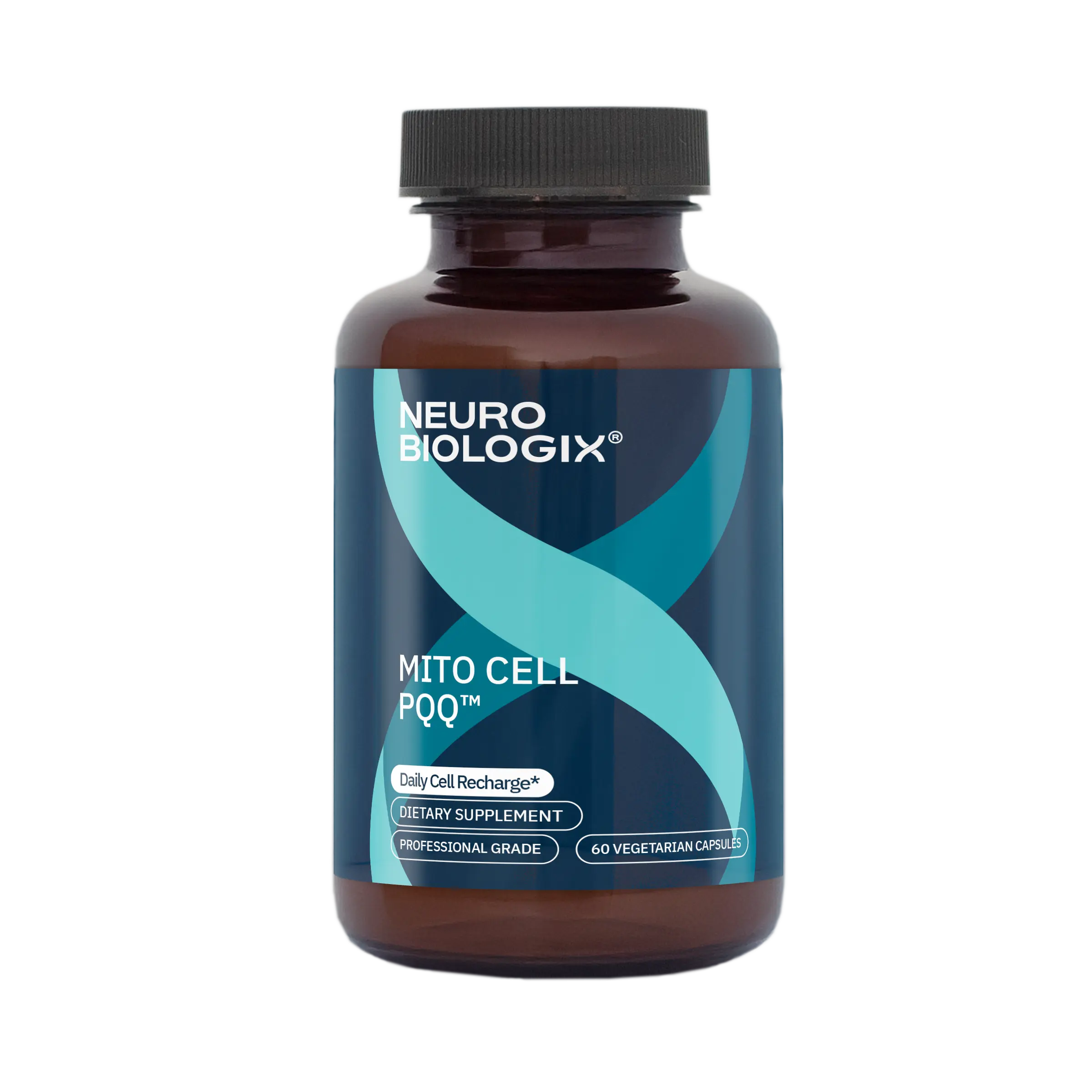
Not maintenance. Growth.
PQQ is one of the only compounds shown to activate genes that promote mitochondrial biogenesis — the growth of new mitochondria, not just upkeep of existing ones.
The full cellular stack.
PQQ triggers growth. CoQ10 fuels the electron transport chain. NADH carries energy. Acetyl-L-Carnitine ferries fat into the matrix. Resveratrol and Quercetin protect. Each ingredient does real work.
Start slow, titrate up.
Mitochondrial shifts are real. Begin at one capsule daily for 2–4 weeks before stepping up to the full dose — an approach many practitioners recommend for sensitive systems.
MAY BENEFIT
Energy is made,
not found.
Formula
Every ingredient works. Every dose is clinical.
KEY INGREDIENTS
OTHER INGREDIENTS
Hypromellose (capsule), Microcrystalline Cellulose, Silicon Dioxide, Ascorbyl Palmitate, Dicalcium Phosphate.
DIRECTIONS
Adults: 2 capsules daily in the AM with food.
Children: 1 capsule in the AM with food or as directed by a practitioner.
Easing in is recommended — begin at 1 capsule daily for 2–4 weeks, then move to the full dose. Consult a practitioner if pregnant or lactating.

Questions
Frequently asked.
What makes PQQ different from CoQ10 or NAD+ supplements?
Who should take Mito Cell PQQ™?
Why start at one capsule before moving to two?
Can children take this?
Is it safe during pregnancy or while breastfeeding?
What should I expect in the first few weeks?
Does it contain caffeine or stimulants?
Can I take this alongside Methylation Complete™ or Methyl Folate Plus™?
The Science
The methylation-mitochondria link.
methylation
How methylation shapes mood, focus, and energy
Mood, focus, and energy aren't separate systems — they run on the same methyl groups. Here's how the methylation cycle underwrites neurotransmitter chemistry, mitochondrial output, and the difference between a good day and a flat one.
Apr 4, 2026 →detox
Glutathione: the master antioxidant, explained
Glutathione is the body's most abundant intracellular antioxidant — central to detoxification, redox balance, and immune function. Here's what it actually does, why it declines, and how your biochemistry makes (or fails to make) it.
Apr 12, 2026 →methylation
The methylation cycle, explained — from DNA to neurotransmitters
Methylation runs in every cell, every second of your life. Here's what the cycle actually does — from activating folate to building dopamine — and why it's the quietest system in the body until it isn't.
Feb 13, 2026 →Peer-reviewed support
The biology of cellular energy.
Selected peer-reviewed research on the mitochondrial, bioenergetic, and antioxidant pathways engaged by the ingredients in Mito Cell PQQ.
-
[01]
Jonscher KR, Chowanadisai W, Rucker RB. Pyrroloquinoline-Quinone Is More Than an Antioxidant: A Vitamin-like Accessory Factor Important in Health and Disease Prevention. Biomolecules. 2021;11(10):1441.
PMID: 34680074 -
[02]
Harris CB, Chowanadisai W, Mishchuk DO, Satre MA, Slupsky CM, Rucker RB. Dietary pyrroloquinoline quinone (PQQ) alters indicators of inflammation and mitochondrial-related metabolism in human subjects. J Nutr Biochem. 2013;24(12):2076-84.
PMID: 24231099 -
[03]
Zhao RZ, Jiang S, Zhang L, Yu ZB. Mitochondrial electron transport chain, ROS generation and uncoupling (Review). Int J Mol Med. 2019;44(1):3-15.
PMID: 31115493 -
[04]
Covarrubias AJ, Perrone R, Grozio A, Verdin E. NAD+ metabolism and its roles in cellular processes during ageing. Nat Rev Mol Cell Biol. 2021;22(2):119-141.
PMID: 33353981 -
[05]
Traina G. The neurobiology of acetyl-L-carnitine. Front Biosci (Landmark Ed). 2016;21(7):1314-29.
PMID: 27100509 -
[06]
Lagouge M, Argmann C, Gerhart-Hines Z, Meziane H, Lerin C, Daussin F, Messadeq N, Milne J, Lambert P, Elliott P, Geny B, Laakso M, Puigserver P, Auwerx J. Resveratrol improves mitochondrial function and protects against metabolic disease by activating SIRT1 and PGC-1alpha. Cell. 2006;127(6):1109-22.
PMID: 17112576 -
[07]
Mlcek J, Jurikova T, Skrovankova S, Sochor J. Quercetin and Its Anti-Allergic Immune Response. Molecules. 2016;21(5):623.
PMID: 27187333 -
[08]
Ionescu-Tucker A, Cotman CW. Emerging roles of oxidative stress in brain aging and Alzheimer's disease. Neurobiol Aging. 2021;107:86-95.
PMID: 34416493
*These statements have not been evaluated by the FDA. This product is not intended to diagnose, treat, cure, or prevent any disease.